

The abiotic model#
Warning
The process-based abiotic model is currently the default abiotic model version in the Virtual Ecosystem configuration; however, the model is still under development. This page provides a summary of the current status and the directions in which we aim to take the model development forward.
Required variables#
The tables below show the variables that are required to initialise the abiotic model and then update it at each time step.
Model overview#
The abiotic model simulates the exchange of energy, water, and heat between the land surface, vegetation canopy, soil, and atmosphere. These processes regulate microclimate conditions that directly influence ecosystem dynamics.
To ensure numerical stability and capture sub-daily variability, the model operates on a reconstructed mean diurnal cycle, derived from monthly mean input data.
Temporal resolution strategy#
The mean diurnal cycle#
Calculating abiotic processes at coarse temporal resolution (e.g. monthly) can introduce numerical instability and obscure important sub-daily dynamics. To address this, the model simulates a single representative (average) day for each month. From monthly mean inputs, a full diurnal cycle is reconstructed, allowing processes to be resolved at hourly time steps.
The resulting hourly values are then used to derive monthly means and ranges of state variables required by other models.
Diurnal cycle reconstruction#
Monthly mean climate variables at reference height above the canopy are converted into hourly values over a 24-hour period using simplified, physically motivated assumptions.
Air temperature follows a sinusoidal cycle, peaking in the early afternoon (~14:00). The amplitude is defined by a prescribed daily temperature range (currently part of the model configuration), which produces a smooth oscillation around the monthly mean.
Incoming shortwave radiation is distributed across daylight hours using a half-sine curve which is zero at night and peaks at midday. The resulting hourly fractions are normalised and used to distribute monthly shortwave absorption across hours, layers, and grid cells. Incoming longwave radiation is assumed to be constant throughout the day.
Note
Daylength is estimated from month and latitude and is constrained between 6 and 18 hours. Sunrise and sunset are then calculated symmetrically around noon.
The mean latitude of the grid has to be provided to the model configuration. In the future, this will be determined internally from the input model data projection and extent.
Relative humidity is computed assuming constant atmospheric vapour pressure. Saturation vapour pressure depends on temperature, actual vapour pressure is derived from monthly mean humidity, and hourly humidity is computed from their ratio. Values are constrained between 0 and 100%.
Evapotranspiration is distributed hourly proportional to absorbed radiation when present and uniform when radiation is absent. Soil evaporation follows the same approach, using total absorbed radiation across layers to determine hourly scaling.
Numerical workflow#
At each Virtual Ecosystem model time step, a sequence of steps is executed as illustrated in Fig. 8.
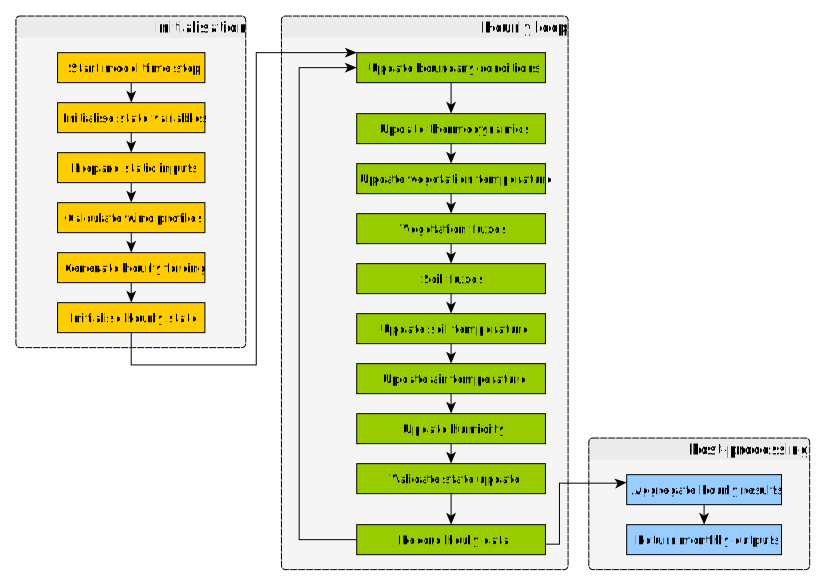
Fig. 8 Numerical workflow of the abiotic model, starting with initialisation (yellow), followed by 24 runs of the hourly loop (green), and closed with post-processing (blue). Static variables are variables that are updated by the abiotic model but held constant during the diurnal cycle. This currently includes atmospheric pressure and \(\ce{CO2}\) and the wind profiles. State variables refer to all variables that are updated hourly by the abiotic model. This includes vertical profiles of air temperature, relative humidity, soil temperature, and energy fluxes, for full list see list of updated variables. The aggregation step at the end returns mean values of the representative day.#
Energy balance framework#
The exchange of energy between the Earth’s surface or canopy and the surrounding atmosphere involves five important categories of processes:
Absorption and emission of electromagnetic radiation by the surface/canopy
Thermal conduction of heat energy within the ground
Turbulent transfer of heat energy towards or away from the surface within the atmosphere
Evaporation, transpiration, and condensation of water
Primary productivity
Each of these processes can be associated with an energy flux density, which is the rate of transfer of energy normal to a surface of unit area (in \(\mathrm{W\,m^{-2}}\)).
The energy balance of a surface layer of finite depth and unit horizontal area can be written as:
where each term is later expanded for the canopy, and soil surface.
Variable definitions:
\(Q\): Total heat energy stored in the surface layer.
\(R_n\): Net surface irradiance (commonly referred to as the net radiation). It represents the gain of energy by the surface from radiation. It is a positive number when it is towards the surface. This includes long- and shortwave radiation.
\(G\): Ground Heat Flux. It is the loss of energy by heat conduction through the lower boundary. It is a positive number when it is directed away from the surface into ground. The value at the surface is denoted \(G_{0}\).
\(H\): Sensible Heat Flux. It represents the loss of energy by the surface by heat transfer to the atmosphere. It is positive when directed away from the surface into the atmosphere.
\(\lambda E\): Latent Heat Flux. It represents a loss of energy from the surface due to evaporation and/or transpiration. (\(\lambda\) is the specific latent heat of evaporation, units \(\mathrm{J\,kg^{-1}}\) and E is the evaporation rate, with units \(\mathrm{kg\,m^{-2}\,s^{-1}}\)).
\(PP\): Primary productivity, represents the energy that plants use to photosynthesize.
Radiative forcing#
Net radiation#
The net radiation \(R_n\) (\(\mathrm{W\,m^{-2}}\)) at the leaf or soil surface is calculated as:
where:
\(S_0\): Incoming shortwave radiation (\(\mathrm{W\,m^{-2}}\))
\(\alpha\): Surface albedo, the fraction of shortwave radiation reflected (–)
\(LW_{down}\): Incoming longwave radiation (\(\mathrm{W\,m^{-2}}\))
\(\epsilon_s\): Surface emissivity, the efficiency of longwave radiation emission (–)
\(\sigma\): Stefan–Boltzmann constant (\(5.67 \times 10^{-8}\,\mathrm{W\,m^{-2}\,K^{-4}}\))
\(T\): Surface temperature (°C)
Shortwave radiation \(S_0\) and longwave radiation \(LW_{down}\) are progressively attenuated through the canopy, as leaves absorb a portion of the incoming radiation. We account for the fact that some of the absorbed shortwave radiation is used by the plants to photosyntheses and is therefore not available for the generation of heat fluxes.
Note
In the future, we aim to implement a more advance radiative transfer scheme, including:
the effects of topography on sun angle, and
the contribution of diffuse radiation.
Canopy processes#
Canopy energy balance#
Given that the time increments of the model are one hour, we can assume that below-canopy heat and vapour exchange attain steady state and heat storage in the canopy does not need to be simulated explicitly (Maclean and Klinges, 2021).
Under steady-state, the balance equation \(\frac{dQ}{dt}\) for the leaves in each canopy layer is as follows:
where:
\(R_{\text{abs}}\): Shortwave and longwave radiation absorbed by the canopy (\(\mathrm{W\,m^{-2}}\))
\(R_{\text{em}}\): Emitted longwave radiation from the canopy (\(\mathrm{W\,m^{-2}}\))
\(H_{l}\): Sensible heat flux from the canopy to the air (\(\mathrm{W\,m^{-2}}\))
\(\lambda E_{l}\): Latent heat flux associated with transpiration from the canopy to the air (\(\mathrm{W\,m^{-2}}\))
\(\epsilon_{l}\): Emissivity of the leaf (-), typically close to 1
\(\sigma\): Stefan–Boltzmann constant (\(5.67 \times 10^{-8}\,\mathrm{W\,m^{-2}\,K^{-4}}\))
\(T_{l}\): Temperature of the leaf (°C)
\(T_{a}\): Temperature of the air surrounding the leaf (°C)
\(\lambda\): Latent heat of vapourisation of water (\(\mathrm{kJ\,kg^{-1}}\))
\(e_{l}\): Effective vapour pressure of the leaf (kPa)
\(e_{a}\): Vapour pressure of air (kPa)
\(p_{a}\): Atmospheric pressure (kPa)
\(g_{v}\): Conductance for vapour loss from the leaves (\(\mathrm{mol\,m^{-2}\,s^{-1}}\)) as a function of the stomatal conductance \(g_{c}\) (\(\mathrm{s\,m^{-1}}\))
\(PP\): Primary productivity, represents the energy that plants use to photosynthesize
Temperature solution#
A challenge in solving the canopy energy balance is the strong nonlinear dependence of radiative and turbulent fluxes on leaf temperature. In particular, emitted longwave radiation scales with the fourth power of temperature, while sensible heat flux depends linearly on the temperature difference between the canopy and the surrounding air.
To solve for the leaf temperature that satisfies the energy balance
we apply a secant method, a derivative-free root-finding approach. This avoids the need to explicitly evaluate the derivative of the energy balance (as in Newton method) while retaining fast convergence.
Air-canopy temperature coupling#
After updating the canopy temperature, we update the air temperature in the adjacent canopy layer to reflect its coupling with the leaf temperature following Bonan (2019):
The sensible heat flux between canopy and air is
and the air temperature evolves as
where:
\(T_a\): Air temperature, (°C)
\(z\): Thickness of the air layer we are updating, (m)
The surface air temperature is diagnosed from the soil and canopy bottom conductances and temperatures, assuming equilibrium between the soil and canopy fluxes. This is necessary because the surface layer is too thin to be updated based on fluxes over a 1-hour timestep, and we want to avoid unrealistic surface air temperatures that would arise from a flux-based update.
Finally, we consider vertical mixing between all vegetation layers and heat is transferred to the air above the canopy.
Note
Advection of heat above the canopy is currently not implemented as everything is removed with time interval >= 1h and horizontal transfer is not considered.
Soil processes#
Soil energy balance#
The energy balance at the soil surface is solved by partitioning net radiation \(R_N\) into different fluxes.
The sensible heat flux from the soil surface is given by:
where:
\(T_s\): Soil surface temperature (°C)
\(T_a\): Air temperature in the bottom atmospheric layer (°C)
\(r_a\): Aerodynamic resistance of the soil surface (\(\mathrm{s\,m^{-1}}\))
\(\rho_{a}\): Air density (\(\mathrm{kg\,m^{-3}}\))
\(c_{p}\): Specific heat capacity of air at constant pressure (\(\mathrm{J\,kg^{-1}\,K^{-1}}\))
The aerodynamic resistance of the soil surface is given by (Barton, 1979):
where:
\(u\): Horizontal wind speed at the bottom air layer (\(\mathrm{m\,s^{-1}}\))
\(C_E\): Drag coefficient for evaporation (–)
The latent heat flux is derived by conversion of surface evaporation as calculated by the hydrology model.
The ground heat flux is calculated as the residual of the energy balance at the soil surface plus the conductive heat from the understorey layer:
Soil temperature update#
After the energy fluxes at the land surface have been partitioned, we simulate how heat is transported vertically through the soil profile by updating the temperature of each soil layer over time. This is done using an explicit finite-difference approach, which numerically solves the one-dimensional heat diffusion equation. The method accounts for thermal diffusivity and the net ground heat flux to calculate temperature changes at each soil depth.
The soil thermal diffusivity \(\alpha\) (\(\mathrm{m^{2}\,s^{-1}}\)) determines the rate at which heat is conducted through the soil. It is defined as:
where:
\(k\): Soil thermal conductivity (\(\mathrm{W\,m^{-1}\,K^{-1}}\)), indicating how easily heat moves through soil
\(\rho_s\): Soil bulk density (\(\mathrm{kg\,m^{-3}}\)), including solids and pore spaces, currently constant across all grid cells and layers
\(c_s\): Soil specific heat capacity (\(\mathrm{J\,kg^{-1}\,K^{-1}}\)), the energy required to raise the temperature of 1 kg of soil by 1 K.
Temperature Update Scheme#
Let \(T_i^t\) represent the temperature (°C) of the \(i^{\text{th}}\) soil layer at time \(t\). The soil column is discretized into \(n\) layers, each of thickness \(\Delta z\) (m), and time advances in steps of \(\Delta t\) (s).
Top layer update (surface boundary condition):
The topmost layer (\(i = 0\)) is updated using the net ground heat flux \(G\) (\(\mathrm{W\,m^{-2}}\)):
Interior layers update:
Each interior layer (\(i = 1, \dots, n-2\)) exchanges heat with adjacent layers following the diffusion equation:
This term approximates vertical conduction using the second spatial derivative of temperature.
Bottom layer update (no-flux boundary condition):
A zero heat flux is assumed at the bottom boundary (\(i = n-1\)), so the bottom layer only exchanges heat with the layer above:
Atmospheric moisture#
Evapotranspiration and soil evaporation are initially provided in millimetres of water depth. These values are converted to a mass of water per unit volume of air (\(\mathrm{kg\, m^{-3}}\)) then added to the relevant atmospheric layers: canopy evapotranspiration is distributed across the layers surrounding the vegetation, while soil evaporation is added to the lowest layer near the surface.
Using the updated water mass, specific humidity is recalculated for each layer by dividing the total water mass by the volume of air in that layer. Then, the new specific humidity is vertically mixed between layers and ventilated at the top of the canopy to make sure that water does not accumulate unrealistcally in the canopy but stays connected to the atmosphere above. To maintain physical realism, additional redistribution steps are taken where necessary until all layers in the canopy are within realistic bounds. The resulting change in specific humidity is then used to compute the new vapour pressure , relative humidity, and vapour pressure deficit. Access water is allocated to condensation which is added to the surface precipitation in the next time step.
Note
Advection of water above the canopy is currently not implemented as everything is removed with time interval >= 1h and horizontal transfer is not considered.
Turbulence and wind#
The wind profile determines the exchange of heat, water, and \(\ce{CO_{2}}\) between soil and atmosphere below the canopy as well as the exchange with the atmosphere above the canopy. The wind speed above the canopy is provided as an input to the model at each time step.
This section describes the implementation of wind profiles within the canopy, friction velocity, aerodynamic resistance, vertical mixing rates, and ventilation rate used to model turbulent mixing with air above the canopy.
The zero-plane displacement height \(d\) (m) is a concept used in micrometeorology to describe the flow of air near the ground or over surfaces like a forest canopy or crops. It represents the height above the actual ground where the wind speed is theoretically reduced to zero due to the obstruction caused by the roughness elements (like trees or buildings).
\(d\) is estimated as a function of canopy height \(h_{c}\) (m), leaf area index \(LAI\) \(\mathrm{m\,m^{-1}}\), and a scaling parameter \(\beta_{d}\) after Maclean and Klinges (2021):
This ensures \(d \to 0\) in the absence of vegetation and approaches a fraction of canopy height in dense vegetation.
The roughness length \(z_0\) (m) determines the height above the ground where the wind speed theoretically becomes zero under neutral atmospheric conditions. It is influenced by the drag imposed by both the substrate and the vegetation canopy. The roughness length is computed as (after Maclean and Klinges (2021)):
with
where \(C_{s}\) is the substrate surface roughness length, \(C_{r}\) is the roughness element (vegetation) drag coefficient, \(C_{d}\) is the roughness sublayer depth parameter, \(\kappa\) is the von Karman constant, and \(LAI\) is the leaf area index (\(\mathrm{m\,m^{-1}}\)).
The wind speed (\(\mathrm{m\,s^{-1}}\)) at any height \(z\) (m) is computed using the logarithmic wind profile under neutral conditions (based on Holmes and Bekele (2020)):
where \(u(z)\) is wind speed at height \(z\), \(u_{\text{ref}}\) is reference wind speed at height \(z_{\text{ref}}\), \(d\) is the zero-plane displacement height, \(z_{0}\) is the roughness length.
Minimum wind speed is enforced below the canopy to avoid unrealistically low turbulent transport.
Friction velocity \(u_{*}\) (\(\mathrm{m\,s^{-1}}\)) quantifies the shear stress imposed by wind near the surface and is calculated from the wind speed profile (based on Holmes and Bekele (2020)):
Friction velocity is used to estimate turbulence strength and mixing coefficients.
The aerodynamic resistance \(r_a\) (\(\mathrm{s\,m^{-1}}\)) quantifies the resistance to vertical transfer of scalars (heat, water vapour) between surface and air (based on Jansson and Karlberg (2004)):
Separate values are computed for:
Canopy resistance, using wind speeds within the canopy layer.
Soil resistance, passed as an external input from the hydrology model.
Note
We currently distinguish between daytime and night time values or aerodynamic resistance . The calculation above are true for daytime conditions; during nighttime, values are set to a constant value which can be defined in the model configuration. This will be updated once the nighttime wind speed can be calculated reliably.
The eddy diffusivity or turbulent mixing coefficients for heat (\(k_H\)) and momentum (\(k_M\)) (\(\mathrm{m^{2}\,s^{-1}}\)) are used to mix water and energy in the canopy. Inside the canopy, turbulence is strongly damped by vegetation drag, and a simple linear profile like used for the top of the canopy like \(k_{H,M} = \kappa u^{*}(z-d)\) (Raupach et al., 1996) does not match observed eddy diffusivity well. Instead, empirical profiles based on measurements are used, and these often take parabolic or other non-linear forms like:
where \(\kappa\) is the von Karman constant (dimensionless), \(u_{*}\) is the friction velocity (\(\mathrm{m\,s^{-1}}\)), \(z\) is the height (m) for which coefficients are calculated, and \(h_c\) is the canopy height (m).
This particular form goes to zero at both z=0 and z=h and peaks somewhere within the canopy.
The ventilation rate \(v\) represents the rate of air exchange above the canopy and is defined as (after Wolfe et al. (2011)):
Where \(r_a\) is the aerodynamic resistance from the top canopy layer and \(h\) is the vertical scale of exchange, or characteristic height, here canopy height (m).
This rate is used to estimate convective removal of heat and water vapour from the canopy.
Generated variables#
The calculations described above result in the following variables being calculated and saved within the data object, and then updated
Updated variables#
The link below provides the complete set of model variables that are updated at each model step.