

The Virtual Ecosystem core configuration#
The core configuration of the Virtual Ecosystem sets up the following parts of the simulation, which are shared across all of the science models. Each of these parts is configured in its own configuration section:
the spatial grid (
[core.grid]),the temporal extent and resolution (
[core.timing]),the vertical layer structure (
[core.layers]),the core constants (
[core.constants]), andthe data output settings for a simulation (
[core.data_output_options]).
The core configuration section is also used to set the location of data input files for
required forcing variables for the simulation, but the [core.data] section is
discussed in the using your own data tutorial.
Tip
You may find it useful to create the core TOML configuration for your system as the first step in developing your own simulations. You can then load the TOML settings into data preparation scripts used to create other VE inputs. This can help keep the various data settings aligned across your project.
Validation of the core configuration#
Each of the model configuration options has specific validation settings that are enforced when a configuration is loaded. These constraints should be described in the documentation of each setting. If configuration data contains invalid values, then the simulation will exit and the log will contain a detailed breakdown of any configuration validation issues.
The spatial grid#
The [core.grid] configuration section is central to a Virtual Ecosystem simulation and
defines a set of grid cells within which the simulation will run. Each cell can have its
own climate and elevation and may contain different plant and animal communities. The
relative elevations of the cells will also define the hydrology of the simulation.
At present, simulations only support rectangular arrays of square grid cells: you can set the number of cells and their area in square metres. You can also set an offset for the origin coordinates of the grid. This can be useful if you want to match your simulation coordinates to incoming data that has real world coordinates from a projected coordinate system.
[core.grid]
grid_type = "square"
cell_area = 8100.0
cell_nx = 9
cell_ny = 9
xoff = -45.0
yoff = -45.0
- core.grid.grid_type
The grid cell type. The value must be one of the options supported by the :data:
~virtual_ecosystem.core.grid.GRID_REGISTRY. Default = square- core.grid.cell_area
The area of each grid cell (m^2) Default = 8100.0
- core.grid.cell_nx
Number of grid cells in x direction Default = 9
- core.grid.cell_ny
Number of grid cells in y direction Default = 9
- core.grid.xoff
The x offset of the grid origin Default = -45.0
- core.grid.yoff
The x offset of the grid origin Default = -45.0
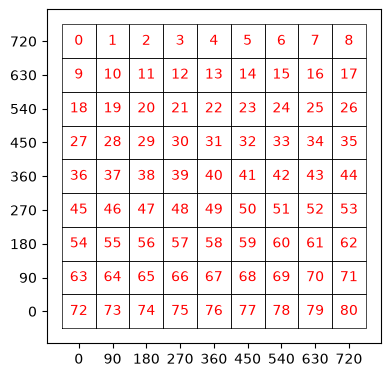
When running a simulation, the Virtual Ecosystem assigns a unique numeric cell id to each cell and these cell ids are widely used in data outputs. They are simply increasing integers starting from zero in the top left and increase across rows first ‘row major’ order. The default values above result in the grid layout, coordinates and cell id values shown below: a 9x9 grid of 90m resolution cells, with the coordinate origin in the centre of the lower left cell.
Important
You need to make sure that all spatially structured input data - which is nearly all of the required starting variables for a simulation - is congruent with the grid configuration you use. That might be using the unique cell id codes or providing data as spatial grids in NetCDF format using the cell coordinates from your configuration.
The temporal extent and resolution#
The [core.timing] configuration section sets the temporal resolution of the simulation
and the total number of time steps. You need to provide a start date, the time interval
of updates and the total run length. The update interval and total run length can be
provided as string descriptions.
[core.timing]
start_date = "2013-01-01"
update_interval = "1 month"
run_length = "2 years"
- core.timing.start_date
The simulation start date. Default = 2013-01-01
- core.timing.update_interval
The interval at which all models are updated. Default = 1 month
- core.timing.run_length
The total run length of the simulation. Default = 2 years
Important
You need to make sure that all temporally structured input data is congruent with the timing configuration you use. That will typically be providing a time axis within a NetCDF file that matches the number of time steps defined above.
The vertical layer structure#
The [core.layers] configuration section defines the vertical layer structure of the
simulation. The model uses a fixed number of layers along the vertical height axis: this
configuration is used to set the actual heights of layers - sometimes relative to the
canopy layer heights - and the number of layers. See the vertical structure
implementation
page for more details.
[core.layers]
soil_layers = [
    -0.25,
    -1.0,
]
canopy_layers = 10
above_canopy_height_offset = 2.0
subcanopy_layer_height = 1.5
surface_layer_height = 0.1
- core.layers.soil_layers
A list of negative float values that provides the depth in metres of the soil horizons to be used in the simulation, hence also setting the number of soil layers and the horizon depth for each layer relative to the surface. The values must be unique and strictly decreasing. Default = [-0.25, -1.0]
- core.layers.canopy_layers
The maximum number of canopy layers to simulate. This is used to control the number of layers with the
canopyrole. Not all of these layers necessarily contain canopy during a simulation as the canopy structure within these layers is dynamic. Default = 10- core.layers.above_canopy_height_offset
A height offset relative to the canopy top that is used as the measurement height of reference climate data. It sets the the height above the canopy top of the first layer role
above(metres). Default = 2.0- core.layers.subcanopy_layer_height
The height above ground level of the ground surface atmospheric layer, used to calculate subcanopy microclimate conditions (metres). Default = 1.5
- core.layers.surface_layer_height
The height above ground level of the ground surface atmospheric layer (metres). Default = 0.1
Data output settings#
The [core.data_output_options] section is used to control when data is exported from
the simulation.
[core.data_output_options]
out_path = "<DIRPATH_PLACEHOLDER>"
output_data_file_name = "model_data.zarr"
save_compiled_configuration = true
compiled_configuration_file_name = "compiled_configuration.toml"
variables_to_save = []
- core.data_output_options.out_path
Directory path for output files Default = <DIRPATH_PLACEHOLDER>
- core.data_output_options.output_data_file_name
The output file name for the model data. Default = model_data.zarr
- core.data_output_options.save_compiled_configuration
Whether to save a TOML file containing the compiled configuration for a model Default = True
- core.data_output_options.compiled_configuration_file_name
The output file name for the compiled configuration TOML file. Default = compiled_configuration.toml
- core.data_output_options.variables_to_save
A list of output variables to save from the model. If this list is empty then all variables will be saved. Default = ()
Core constants#
The [core.constants] section defines a set of constants values that are shared across
the whole simulation. This includes some global constants, as well as some values
that are required across multiple models.
[core.constants]
standard_pressure = 101.325
standard_mole = 44.642
molar_heat_capacity_air = 29.19
gravity = 6.6743e-11
boltzmann_constant = 1.380649e-23
stefan_boltzmann_constant = 5.6703744191844314e-08
von_karmans_constant = 0.4
microbial_simulation_depth = 0.25
meters_to_mm = 1000.0
mm_to_kg = 0.001
molecular_weight_air = 28.96
gas_constant_water_vapour = 461.51
seconds_to_day = 86400.0
seconds_to_hour = 3600.0
hours_per_day = 24
characteristic_dimension_leaf = 0.01
specific_gas_constant_dry_air = 287.05
molecular_weight_ratio_water_to_dry_air = 0.622
conductance_to_resistance_conversion_factor = 40.9
density_water = 1000.0
fungal_fruiting_bodies_c_n_ratio = 10.0
fungal_fruiting_bodies_c_p_ratio = 75.0
fungal_fruiting_bodies_decay_rate = 0.013862943611198907
air_volumetric_heat_capacity = 1200.0
initial_aerodynamic_resistance_canopy = 12.1
- core.constants.standard_pressure
Standard atmospheric pressure, [kPa] Default = 101.325
- core.constants.standard_mole
Moles of ideal gas in 1 m^3 air at standard atmosphere. Default = 44.642
- core.constants.molar_heat_capacity_air
Molar heat capacity of air, [J mol-1 K-1]. Default = 29.19
- core.constants.gravity
Newtonian constant of gravitation, [m s-1]. Default = 6.6743e-11
- core.constants.boltzmann_constant
The Boltzmann constant, [J K-1] Default = 1.380649e-23
- core.constants.stefan_boltzmann_constant
Stefan-Boltzmann constant, [W m-2 K-4].
The Stefan-Boltzmann constant relates the energy radiated by a black body to its temperature. Default = 5.6703744191844314e-08
- core.constants.von_karmans_constant
Von Karman’s constant, [unitless].
The von Karman’s constant describes the logarithmic velocity profile of a turbulent fluid near a no-slip boundary. Default = 0.4
- core.constants.microbial_simulation_depth
Depth to which soil-microbial simulation extents [m].
As the soil-microbial model is a topsoil model the maximum soil depth included in the simulation needs to be set. This is then used to identify which of the configured soil layers are sufficiently close to the surface to be included in the calculations of the soil-microbial model. The default value is taken from Fatichi et al. (2019). No empirical source is provided for this value. Default = 0.25
- core.constants.meters_to_mm
Factor to convert variable unit from meters to millimeters. Default = 1000.0
- core.constants.mm_to_kg
Factor to convert variable unit from millimeters to kilograms of water per square metre. Default = 0.001
- core.constants.molecular_weight_air
Molecular weight of air, [g mol-1]. Default = 28.96
- core.constants.gas_constant_water_vapour
Gas constant for water vapour, [J kg-1 K-1] Default = 461.51
- core.constants.seconds_to_day
Factor to convert variable unit from seconds to day. Default = 86400.0
- core.constants.seconds_to_hour
Factor to convert variable unit from seconds to hours. Default = 3600.0
- core.constants.hours_per_day
Number of hours per day. Default = 24
- core.constants.characteristic_dimension_leaf
Characteristic dimension of leaf, typically around 0.7 * leaf width, [m]. Default = 0.01
- core.constants.specific_gas_constant_dry_air
Specific gas constant for dry air, [J kg-1 K-1]. Default = 287.05
- core.constants.molecular_weight_ratio_water_to_dry_air
The molecular weight ratio of water to dry air.
The ratio of the molar mass of water vapour (18.015 g/mol) to the molar mass of dry air (28.964 g/mol), which is approximately 0.622. This ratio is used in atmospheric calculations, particularly in determining the mixing ratio of water vapour to dry air. Default = 0.622
- core.constants.conductance_to_resistance_conversion_factor
Conductance to resistance conversion factor.
This factor is used to convert between stomatal conductance in mmol m-2 s-1 and stomatal resistance in s m-1. Default = 40.9
- core.constants.density_water
Density of water, [kg m-3]. Default = 1000.0
- core.constants.fungal_fruiting_bodies_c_n_ratio
Carbon to nitrogen ratio of fungal fruiting bodies, [unitless].
This constant is stored in the CoreConsts as it is used by both the animal model (to work out consumption flows) and the soil model (to work out production rates). The current default value is very much a guess. Default = 10.0
- core.constants.fungal_fruiting_bodies_c_p_ratio
Carbon to phosphorus ratio of fungal fruiting bodies, [unitless].
This constant is stored in the CoreConsts as it is used by both the animal model (to work out consumption flows) and the soil model (to work out production rates). The current default value is very much a guess. Default = 75.0
- core.constants.fungal_fruiting_bodies_decay_rate
Rate constant for the decay of fungal fruiting bodies, [day^-1].
This is calculated based on the assumption that fungal fruiting bodies decay with a half-life of 50 days. This estimate should be improved based on empirical data. Default = 0.013862943611198907
- core.constants.air_volumetric_heat_capacity
Volumetric heat capacity of air at constant pressure, [J m-3 K-1].
This represents the amount of heat energy required to raise the temperature of one cubic meter of air by 1 Kelvin. Default = 1200.0
- core.constants.initial_aerodynamic_resistance_canopy
Initial aerodynamic resistance of the canopy, [s m-1].
This parameter is an initial estimate of the resistance to the transfer of momentum, heat, and water vapour between the leaf surface and the atmosphere. The value is based on Australian evergreen forest, taken from Su et al. (2021); note that this assumes a dense canopy. Default = 12.1